
Roof Pricing Just Got Smarter (AI Changes the Game)
See how one contractor cut estimates from 3 hours to 15 minutes
The Ridge Insights
Welcome to The Ridge Insights!
When a hail storm doubles your permit count in ten weeks and out-of-state crews flood your market, you’re not just scaling—you’re fighting to protect margin in real time. Today: what happens when demand surges, what PE buyers are paying for, and the systems you need to track job-level profit when you’re running a 300-job backlog.
What’s in this issue:
- 🌩️ Minnesota storm surge: 306 permits in 10 weeks and what it means for scheduling and cash flow
- 💰 PE acquisition deep dive: what HighPoint paid for in Nashville and why insurance restoration capability matters
- 📊 Trimble’s new financials platform: real-time job costing for roofing shops under $10M
- 🤝 Succession planning case study: how a 35-year contractor handed off without losing clients
- 🔧 Capital City Roofing’s AI pricing system: 27-point inspection, 100-point scoring, same-day proposals
💡 Quote of the Day
“Growth, exit value, and operational control all depend on the same thing—knowing your numbers per job, in real time.”
— Shareef Huddle, Founder of Huddle Web Works
📰 Latest News
🔗 Roofing permits soar as construction companies catch up (9 minute read)
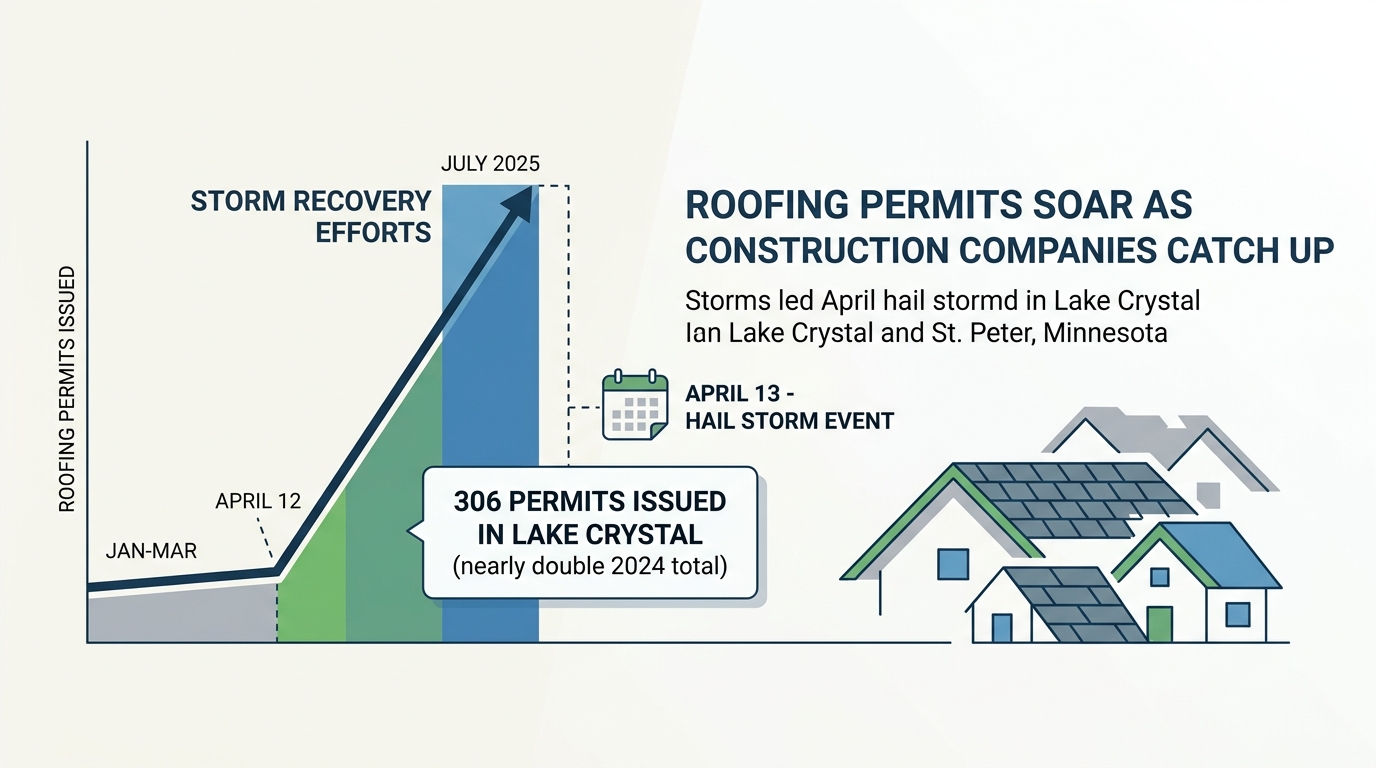
After an April 13 hail storm devastated Lake Crystal and St. Peter, Minnesota, roofing permit volume exploded. Lake Crystal issued 306 permits by early July—nearly double their entire 2025 total of 177—potentially affecting over half the city’s 861 properties. St. Peter processed 515 roofing permits. Despite record heat and poor air quality, construction crews worked frantically to complete insurance-claim repairs. Notably, 58 of 79 contractors in St. Peter were outsiders who arrived immediately after the storm, overwhelming homeowners with door-to-door sales pitches and creating unprecedented administrative challenges for city staff.
Key Points:
- Lake Crystal issued 306 permits in 10 weeks versus 177 for all of 2025—a demand surge affecting over half the city’s properties
- 58 out of 79 contractors in St. Peter were out-of-state crews who showed up immediately after the storm
- City staff faced unprecedented administrative bottlenecks processing permits while managing the flood of outside contractors
Why it matters: This is what catastrophe demand actually looks like on the ground—your market doubles overnight, your backlog goes from 30 days to 120, and you’re competing with 58 out-of-state crews who showed up with door hangers before the debris was cleared. The twin challenges: scaling fast enough to capture the work and protecting margin when material lead times stretch and labor costs spike. If you can’t track job-level cost in real time when you’re running a 300-job backlog, you won’t know you’re bleeding until Q4. And by then, the storm chasers are gone and you’re stuck with the callbacks.
🔗 HighPoint Exterior Home Services Announces Partnership with Five Points Roofing Company (5 minute read)

HighPoint Exterior Home Services, backed by Lake Street Capital Partners, has partnered with Five Points Roofing, a Nashville-based residential roofing company founded in 2010. This strategic expansion strengthens HighPoint’s presence in the Southeast’s booming real estate market, particularly Tennessee. Five Points, led by founder Logan Hughes and an experienced management team, specializes in roof replacement, restoration, and insurance claims management. The partnership leverages HighPoint’s operational expertise and financial resources to accelerate Five Points’ growth across Tennessee while maintaining its reputation for exceptional craftsmanship and customer service.
Key Points:
- PE-backed platform HighPoint acquired Nashville-based Five Points Roofing to expand Southeast footprint
- Five Points brings insurance restoration capability, established management team, and 15-year market presence
- Transaction signals what strategic buyers value: claims management expertise and regional density in high-growth markets
Why it matters: This is what PE buyers are paying for right now—insurance restoration capability, an established management team that can run without the founder on every job, and market density in the Southeast. If you’re thinking about an exit in the next 3-5 years, this tells you what to build: documented processes, a bench of managers who can operate independently, and a concentration of jobs in a defined geography. Valuation multiples are driven by predictability, and predictability comes from systems, not heroics. Five Points had that. That’s why they got the call.
🔗 Trimble Continues to Court Smaller Contractors (5 minute read)

Trimble launched Trimble Financials, a construction-specific financial management system designed for businesses with annual revenues under $10 million. This simplified software eliminates the need for accounting expertise, enabling small business owners to manage projects from proposal through closeout. Key features include real-time project visibility, expense tracking by job and cost type, customizable invoicing, and AI-powered support. The platform integrates seamlessly with Trimble’s estimating and performance tracking solutions, unifying office and field operations. This move follows Trimble’s 2024 rollout of machine control technology for smaller equipment fleets.
Key Points:
- Trimble built a financials platform specifically for contractors under $10M in revenue—no accounting degree required
- Real-time job costing, expense tracking by cost type, and AI-powered support built into the system
- Integrates with estimating and field tracking, closing the loop from proposal to invoice in one platform
Why it matters: Most roofing shops under $10M run financials in QuickBooks or spreadsheets and can’t see per-job margin until the job is done—or worse, until tax season. By then, you’ve already lost the money. Trimble Financials is the category maturation of roofing-specific software: estimate to invoice in one system, with AI to reduce bookkeeping labor. This is the infrastructure that lets you track job-level margin in real time, which is exactly what you need when you’re running a 300-job backlog after a storm or preparing for an exit. If you can’t answer “What did we make on that job?” within 48 hours of completion, you’re flying blind.
🔥 Trending
-
Capital City Roofing’s AI Pricing System: Alpharetta-based CCR combines a 27-point inspection with a 100-point AI Condition Index to score roof conditions objectively, delivering same-day proposals and 30-second response times. Operating 80 AI agents for intake, scheduling, and customer communication.
-
Fractional CFO Services for Roofing Companies: Magnified Consulting offers CFO-level financial discipline without full-time overhead—cash flow forecasting, job profitability analysis, margin optimization, and M&A support tailored for roofing’s seasonal demand and working capital needs.
-
Roof Estimating Bottleneck in Property Claims: Average residential roof replacement costs surged to $17,631 in 2025—a 33% increase over four years—while repair costs jumped 25% to $4,699. Roofing represents 30% of all claim line items, making inefficiencies costly.
-
U.S. Remodeler Index Decline Signals Weakening Demand: Index dropped to 57 in Q2 2026 as rising costs, consumer uncertainty, and shrinking backlogs dampen contractor confidence. Labor costs up 10%, material prices up 4-8%, and mid-tier customers delaying projects.
⚡ Quick Hits
🎯 Hug Construction Acquires 35-Year Contractor
Spokane Valley-based Hug Construction acquired Construction Associates of Spokane, a commercial general contracting firm, in a strategic succession-planning move. The July 2026 transaction brought Hug’s workforce to 67 full-time employees, adding 15 specialized staff and a robust pipeline of active projects. Founder Michael Galles, who operated Construction Associates for 35 years, approached Hug about the merger to ensure employee and client continuity. Rather than closing doors, Galles remains involved in the transition, mentoring staff and preserving the company’s customer-focused philosophy. (Read more)
🎯 Homeowner Questions $6,400 Plywood Upsell for Solar Prep
A homeowner planning solar installation within 1-3 years received a shocking roofing estimate: $6,400 extra for a plywood layer atop their 1x6 redwood roof deck. The contractor claimed it was necessary preparation for future solar panels, but the homeowner questioned whether this was a legitimate requirement or an upsell. Reddit commenters offered conflicting advice—some supported the plywood investment to avoid costly panel removal later, while others argued asphalt shingles last 30+ years, matching solar panel lifespans. The key takeaway: always request written explanations for roof modifications, verify if they’re code-required or manufacturer-mandated, and compare line-item pricing across multiple quotes before committing. (Read more)
🎯 Construction Talent Gap is a Leadership Crisis, Not a Recruiting Problem
The construction industry faces a critical 349,000-worker deficit by 2026, but experts argue the real crisis is leadership failure, not labor shortage. Rather than engaging in costly bidding wars for experienced workers, industry leaders should pivot inward, investing in structured apprenticeships and mentorship programs to develop raw talent. Technology platforms like BuilderLync can streamline administrative tasks, freeing experienced crews to mentor newcomers. Companies demonstrating commitment to employee growth enjoy fierce loyalty and reduced turnover. (Read more)
🎓 Industry Insight
Job Costing in Real Time: The Infrastructure Behind Growth and Exit Value
When demand surges—whether from a storm, a hot market, or just good execution—the bottleneck isn’t usually sales. It’s operations. And the operational bottleneck isn’t usually crew capacity. It’s knowing what you’re making per job while you still have time to fix it.
Most roofing shops under $10M run financials in QuickBooks or spreadsheets. They track revenue and expenses at the company level, maybe by month, maybe by quarter. But they don’t know job-level margin until the job is done—or worse, until tax season. By then, you’ve already lost the money. You’ve already priced the next 50 jobs using the same broken assumptions. And you’ve already committed to overhead you can’t support.
Real-time job costing isn’t about accounting. It’s about decision-making. When you can see margin per job within 48 hours of completion, you can adjust pricing, tighten material ordering, and catch labor overruns before they become patterns. When you can’t, you’re flying blind. And when you’re running a 300-job backlog after a storm, flying blind is how you turn a record year into a breakeven year.
This is also what strategic buyers and PE firms are looking for when they evaluate roofing companies. They’re not just buying revenue. They’re buying predictability. And predictability comes from systems—documented processes, real-time financial visibility, and a management team that can operate without the founder on every job. If you’re thinking about an exit in the next 3-5 years, the time to build that infrastructure is now. Because when the buyer shows up, they’re not going to wait for you to get your books in order.
❓ Question of the Day
What’s your biggest operational bottleneck right now?
- A) Job costing and financial visibility
- B) Crew scheduling and capacity
- C) Estimating and proposal turnaround time
- D) Customer communication and follow-up
👋 Wrap Up
Growth, exit value, and operational control all depend on the same thing—knowing your numbers per job, in real time. Whether you’re scaling through a storm surge, preparing for an acquisition, or just trying to protect margin in a competitive market, the infrastructure matters. Systems aren’t overhead. They’re the foundation.
Next issue, we’ll dig into pricing discipline, insurance supplement strategy, and what’s happening with material costs as we head into peak season. Until then, take a hard look at your job costing process. If you can’t answer “What did we make on that job?” within 48 hours of completion, that’s your next fix.
Stay sharp,
Shareef Huddle
📊 How did you like today’s email?
Enjoyed this issue?
Subscribe to get The Ridge Insights delivered to your inbox every week.
Join 95 other subscribers • Free forever