
Ridge Insights: Tech Disruption Reshapes Roofing
Old-school contractors are struggling—here's what the survivors know
The Ridge Insights
Welcome to The Ridge Insights!
Companies are going under at the fastest rate since 2010, but the ones surviving aren’t just working harder—they’re working smarter with technology, tighter cash flow discipline, and strategic supplier relationships. Here’s what separates the survivors from the statistics.
What’s in this issue:
- 💀 Construction business failures hit crisis levels—88 administrations filed in H1 2026 alone
- ⚡ Metal roofing takeoff technology cuts estimate turnaround from days to hours
- 🏢 QXO’s $50B consolidation play and what it means for your material costs
- 💰 How inflation is forcing facility managers to rethink commercial maintenance budgets
- 🎯 Pricing strategies that protect margins when customers are budget-squeezed
💡 Quote of the Day
“The perfect storm of inflationary pressures and delayed payments has pushed businesses to breaking point. Early professional intervention and strict cashflow management are critical survival strategies.”
— UK Construction Industry Analyst, 2026 Administration Report
📰 Latest News
🔗 Construction Business Failures Rise as Most Administrations Filed Since 2010 (4 minute read)
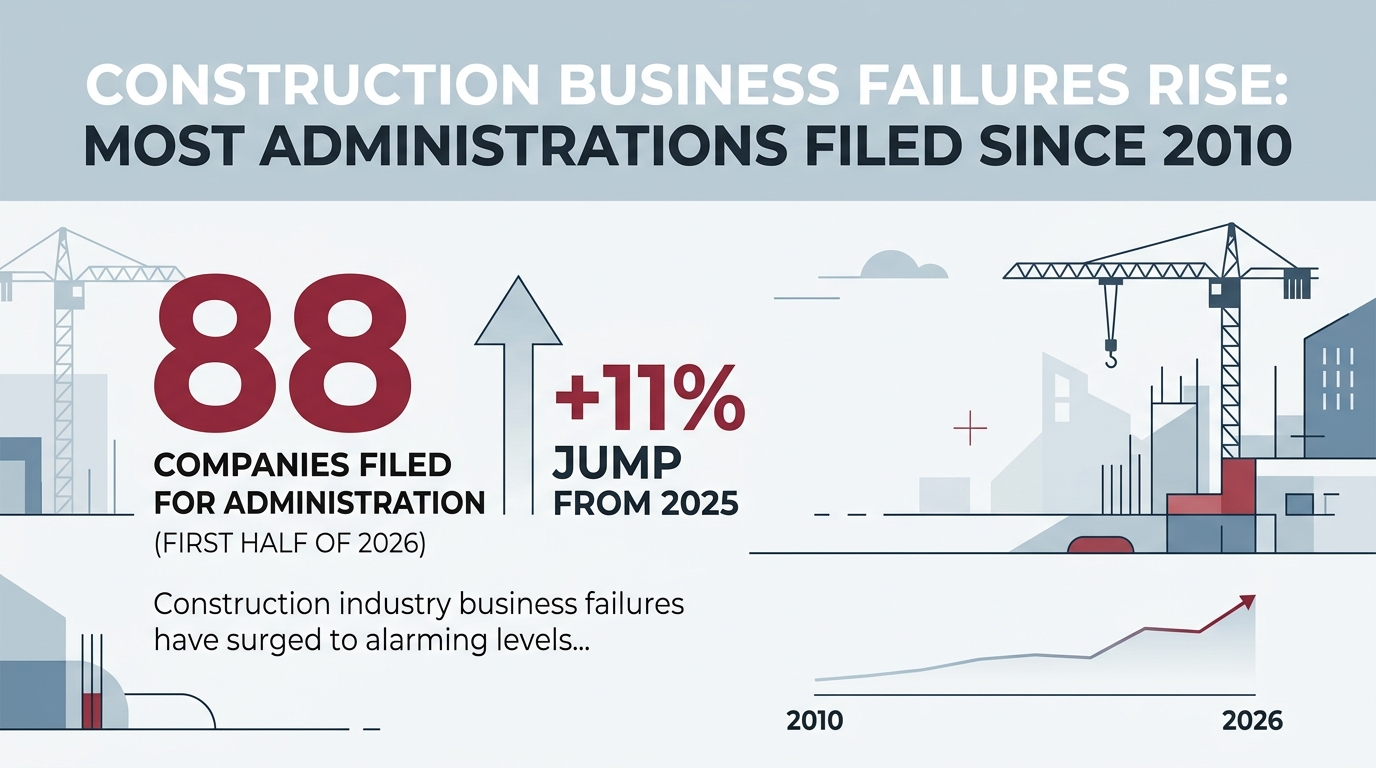
Construction business failures have surged to the highest level since 2010, with 88 companies filing for administration in the first half of 2026—an 11% jump from the previous year. Rising material costs, geopolitical uncertainty, and chronic payment delays are crushing SMEs and specialist subcontractors who lack financial resilience. Nationally, UK administrations hit 1,159 in H1 2026, a 48% increase and the first time exceeding pre-pandemic levels.
Key Points:
- 88 construction administrations filed in H1 2026, marking the sector’s worst performance since the 2010 financial crisis
- Payment delays and cost pressures are the primary killers—not lack of work
- SMEs and specialist subcontractors without cash reserves are most vulnerable to failure
Why it matters: Your competitors are failing from cash flow strain, not lack of work. The companies surviving this aren’t the ones with the most revenue—they’re the ones with receivables discipline, progress billing structures, and early warning systems for financial distress. This is the survival context everything else operates within. If you’re carrying 60+ day receivables or taking deposits that don’t cover your first material order, you’re playing the same game that just put 88 companies into administration.
🔗 From Tape Measures to Technology (9 minute read)

Metal roofing takeoffs are undergoing a digital transformation that’s fundamentally changing competitive dynamics in the bidding process. Traditional measurement methods that took days now happen in hours with aerial measurement apps, AI-driven tools, and integrated platforms like Sherwin-Williams’ Roofing Passport. Unlike asphalt shingles, metal roofing requires custom-fit precision accounting for panel layouts, trim, and waste calculations—making accuracy a direct profit lever.
Key Points:
- Digital tools cut metal roofing estimate turnaround from days to hours—critical when first bid often wins
- Automated measurements connect estimating directly to ordering and manufacturing systems, eliminating transcription errors
- Accurate material calculations protect margins by minimizing waste on custom metal jobs where every panel counts
Why it matters: First bid often wins, and digital measurement tools are the competitive advantage that gets you there. When your competitor is still climbing ladders with a tape measure, you’re sending a detailed quote with panel layouts and trim schedules before the customer calls the second contractor. This isn’t about technology for technology’s sake—it’s about speed-to-bid and margin protection through accurate material calculations. The contractors surviving the current failure wave are the ones who can quote faster and more accurately than their competition.
🔗 QXO Outlines Growth Strategy for Unified Building Platform (4 minute read)
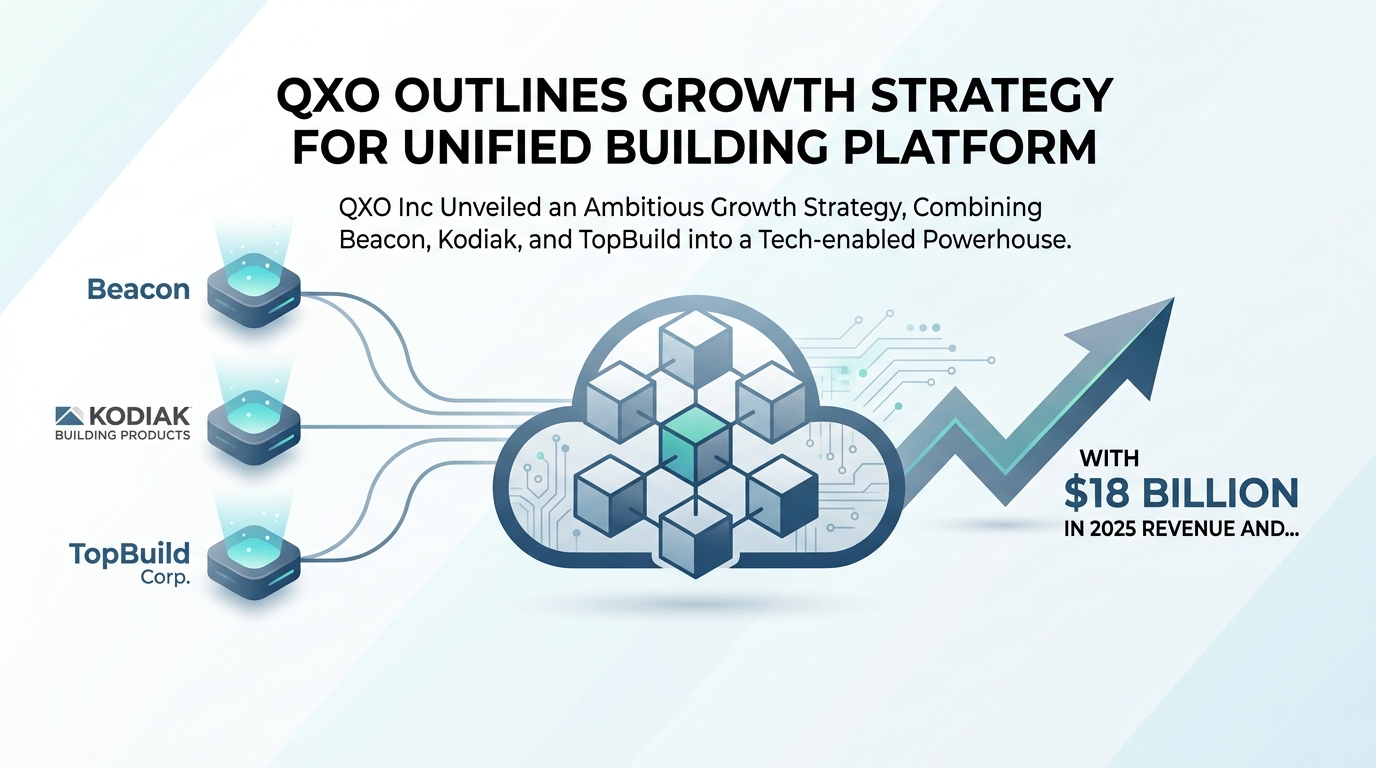
QXO Inc unveiled an ambitious growth strategy combining Beacon, Kodiak, and TopBuild into a tech-enabled powerhouse targeting $50 billion in revenue within a decade. With $18 billion in 2025 revenue and nearly $2 billion in adjusted EBITDA, the company aims to double EBITDA by 2030. QXO holds leading positions in insulation, waterproofing, and roofing distribution across North America, leveraging scale for procurement savings and technology investment.
Key Points:
- QXO completed a $17 billion TopBuild acquisition, consolidating major roofing and building material suppliers
- The company plans to double EBITDA by 2030 through scale, procurement leverage, and technology integration
- Strategy emphasizes “unified building platform” combining multiple distribution channels under centralized management
Why it matters: When your supplier aims to double EBITDA, understand how that affects your costs, terms, and alternatives. Supplier consolidation concentrates pricing power—the company you’ve been buying from for 15 years is now part of a $50B platform with different priorities. This isn’t about being anti-consolidation; it’s about strategic procurement. Maintain relationships with multiple supply channels, understand your volume leverage, and don’t let a single vendor relationship become a dependency. The contractors who navigate this best are the ones who saw it coming and diversified before their primary supplier became their only option.
🔥 Trending
-
QXO’s Scale and Technology Playbook: The building materials consolidation continues with QXO’s integration of Beacon, Kodiak, and TopBuild—backed by a $750 million stock offering to fund the transformation
-
Inflation’s Impact on Commercial Maintenance Budgets: Facility managers face tough budget decisions as material and labor costs remain elevated at 2.7% inflation, but deferring maintenance creates bigger problems
-
Fractional Sales Teams for Trades: NCKTR launches Revenue Division™ to embed Sales Development Representatives into HVAC, plumbing, roofing, and electrical businesses starting at $10K setup + $4,500/month
-
Arizona Roofing Decision Framework: Expert Tyler Johnson outlines repair vs. replacement decision model based on annual cost analysis, condition assessment, and maintenance history
⚡ Quick Hits
🎯 Austin Market Pricing: $15K-$20K for Shingle Roof
Austin homeowners can expect to pay $15,000-$20,000 for a new shingle roof, with costs varying based on size, materials, pitch, and home features. Experts emphasize collecting three estimates and comparing scope, reputation, and value rather than choosing the cheapest bid. Unusually low bids often indicate corner-cutting on materials or installation quality. (Read more)
🎯 Metal Roofing Requires Custom-Fit Precision
Unlike asphalt shingles, metal roofing demands precise calculations for panel layouts, trim, and waste management. Digital measurement tools now connect estimating directly to ordering and manufacturing systems, eliminating transcription errors and protecting margins on jobs where every panel is custom-cut. Speed and accuracy have become competitive differentiators. (Read more)
🎯 Payment Delays Are the Primary Business Killer
Analysis of construction business failures reveals that chronic payment delays—not lack of work—are crushing companies. SMEs and specialist subcontractors without cash reserves are most vulnerable. Experts recommend strict cashflow management, progress billing structures, and early professional intervention when payment cycles stretch beyond 45 days. (Read more)
🎯 Commercial Facility Managers Can’t Defer Maintenance
Despite budget pressure from elevated material and labor costs, facility managers face costly consequences when deferring maintenance to cut short-term expenses. Small issues escalate into major repairs. Strategic capital planning and proactive budgeting are now essential, creating opportunities for contractors who can structure multi-year maintenance contracts that provide budget predictability. (Read more)
🎓 Industry Insight
Pricing Strategy When Customers Are Budget-Squeezed
Inflation is forcing commercial facility managers to make tough budget decisions, but here’s what most contractors miss: customers facing budget pressure don’t want the cheapest option—they want budget predictability and risk mitigation.
When material costs are volatile and labor rates are climbing, structure your commercial proposals around multi-year maintenance agreements that lock in pricing while protecting your margins. Instead of bidding a one-time roof replacement at market rates that might spike next quarter, offer a three-year maintenance contract with scheduled inspections, minor repairs, and a locked-in replacement price if the roof fails within the term.
This approach gives facility managers the budget certainty their CFO is demanding while giving you predictable revenue and margin protection through volume commitment. The key is building enough cushion into your locked pricing to absorb reasonable cost increases, then delivering enough value through proactive maintenance that the customer sees the contract as insurance, not just deferred spending. Price the relationship, not just the transaction—especially when your competitors are still bidding jobs one at a time with no strategic differentiation.
❓ Question of the Day
What’s your biggest operational challenge right now?
- A) Cash flow and receivables management
- B) Estimating speed and accuracy
- C) Material costs and supplier relationships
- D) Finding and retaining skilled labor
👋 Wrap Up
This issue covered the survival fundamentals: 88 companies went into administration in the first half of 2026 because they couldn’t manage cash flow through cost pressure and payment delays. The ones surviving aren’t just working harder—they’re leveraging technology for competitive speed-to-bid advantage, diversifying supplier relationships before consolidation eliminates their options, and structuring pricing strategies that protect margins while giving budget-squeezed customers the predictability they need.
The through-line here is strategic positioning, not tactical hustle. Digital estimating tools, supplier diversification, and value-based pricing aren’t nice-to-haves anymore—they’re the difference between being one of the 88 failures and being one of the survivors who picks up their market share.
Stay sharp,
Shareef Huddle
📊 How did you like today’s email?
Enjoyed this issue?
Subscribe to get The Ridge Insights delivered to your inbox every week.
Join 95 other subscribers • Free forever