
Ridge Insights: Tax Credits + Leadership Shifts Shape Roofing's Future
New tax breaks, pricing transparency, and why one roofing stock keeps winning
The Ridge Insights
Welcome to The Ridge Insights!
The roofing market is shifting under our feet—energy codes are tightening, material innovation is accelerating, and contracts are getting more scrutinized. Today we’re cutting through the noise to show you what actually matters for your business.
What’s in this issue:
- 💰 Federal apprenticeship tax credits that could put $17,500/quarter back in your pocket
- 🏗️ Roofing membranes market hitting $39.78B by 2031—what it means for your product mix
- 📋 Why your contract language needs an audit before storm season
- 🎯 How to price commercial metal roof repairs without leaving money on the table
- 🔧 Workforce development, legal risk, and the long game on material innovation
💡 Quote of the Day
“The companies that will win in the next five years aren’t the ones chasing every lead—they’re the ones who build systems that convert more of what they already have, train the people they already hired, and protect the margin they already earned.”
— Shareef Huddle, Founder of Huddle Web Works
📰 Latest News
🔗 Federal apprenticeship bill teases tax credit to offset training costs (4 minute read)

Congress is considering the WAGES Act, a game-changing bill that would provide roofing contractors with substantial tax credits to offset apprenticeship training costs. The refundable payroll tax credit covers 50% of apprentice wages (up to $5,000/quarter), half of program expenses (up to $2,500/quarter), and mentor wages (up to $10,000/quarter). This addresses a critical industry challenge: 36% of roofing contractors struggle to find qualified workers, while 75% rely on informal in-house training they can’t afford to formalize.
Key Points:
- $5,000/quarter wage credit, $2,500/quarter program cost credit, $10,000/quarter mentor credit—up to $17,500 per apprentice per quarter
- 75% of roofing contractors already do in-house training informally; this formalizes it and turns a cost center into a tax-advantaged system
- Roofer employment projected to grow 6% through 2034—double the national average—while nearly 40% of skilled trades workers are over 45
Why it matters: This isn’t just a workforce development program—it’s a way to formalize the training you’re already doing and get paid for it. If you’re running crews and struggling to find reliable labor, the WAGES Act could subsidize your recruiting and retention pipeline while building a bench of skilled workers who actually stay. With labor scarcity driving up wages and turnover eating margin, a $17,500/quarter credit per apprentice changes the economics of hiring green and training them right.
🔗 Roofing Membranes Market worth $39.78 billion by 2031, at a CAGR of 5.7%, says MarketsandMarkets™ (8 minute read)

The global roofing membranes market is projected to reach $39.78 billion by 2031, growing at a 5.7% CAGR from its current $30.15 billion valuation in 2026. This expansion is driven by rising demand for durable, weather-resistant, energy-efficient waterproofing solutions across residential, commercial, and industrial sectors. Key growth catalysts include rapid urbanization, smart city development, green building initiatives, and rooftop solar applications.
Key Points:
- Advanced membrane technologies—bituminous, synthetic, and liquid-applied systems—are replacing traditional methods
- Environmental regulations and sustainability concerns are spurring innovation in eco-friendly, recyclable membrane solutions
- Asia Pacific leads regional growth, but North American demand is driven by energy codes, solar integration, and green building mandates
Why it matters: This is a market signal for residential and commercial roofers: homeowners and builders are prioritizing energy-efficient, solar-ready systems. If you’re still selling roofs purely on price and warranty length, you’re missing the conversation. Understanding product mix, supplier partnerships, and how to position performance over cost is becoming table stakes. The contractors who can speak fluently about cool-roof membranes, solar readiness, and energy code compliance will win the higher-margin jobs and avoid the race to the bottom.
🔗 Flat Roof Experts LLC Clarifies Pricing for Commercial Metal Roof Work (7 minute read)
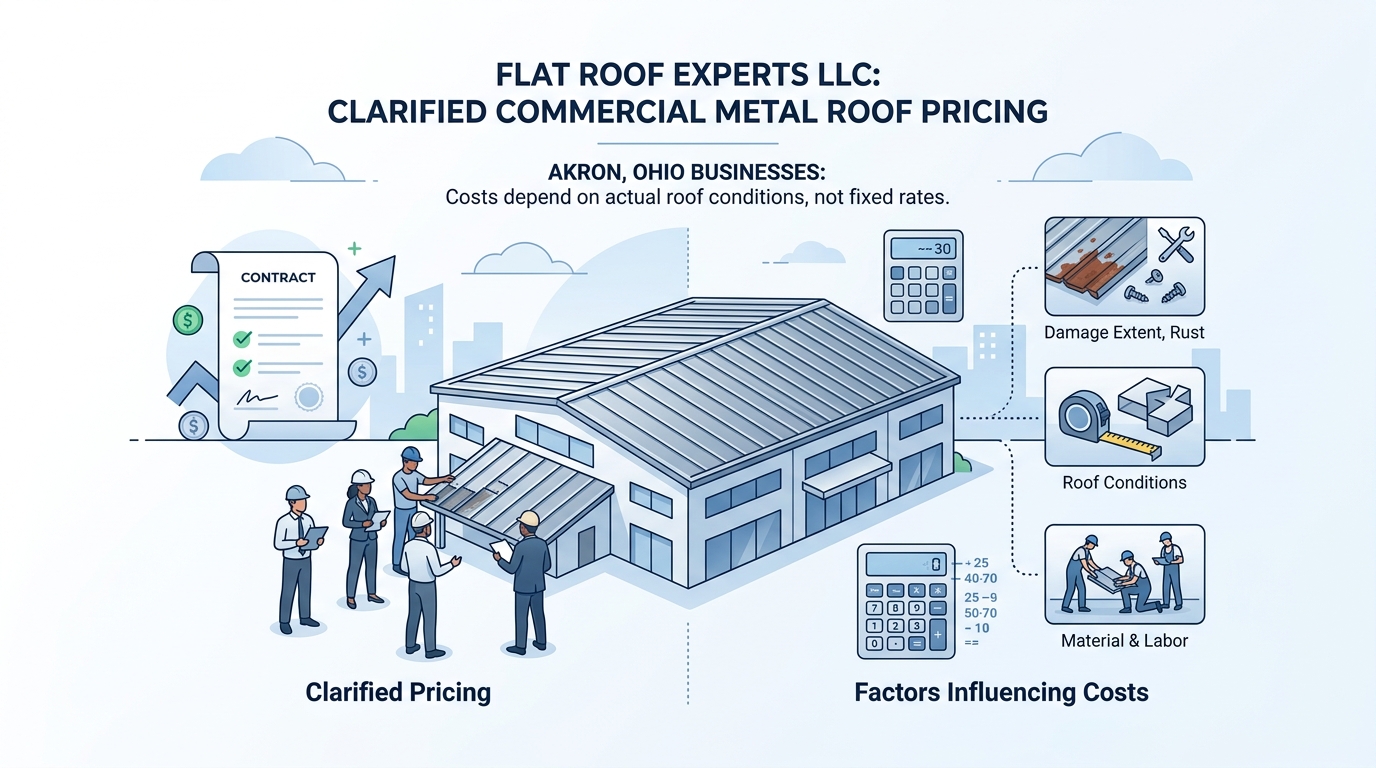
Flat Roof Experts LLC has clarified commercial metal roof repair pricing for Akron, Ohio businesses. Rather than fixed rates, costs depend on actual roof conditions including damage extent, rust development, seam separation, roof size, height, and equipment placement. CEO Raymond Gingerich emphasizes that each commercial roof tells a different story during inspection. The company categorizes repairs into minor work (small leaks, fastener tightening), moderate work (multiple leak points, seam issues), and major work (extensive damage).
Key Points:
- Pricing is condition-based, not rate-based—damage extent, rust, seam separation, roof size, height, and equipment placement all drive cost
- Three-tier repair framework: minor (small leaks, fastener tightening), moderate (multiple leaks, seam issues), major (extensive damage)
- Access challenges and rooftop equipment significantly impact labor requirements and overall costs
Why it matters: This is a case study in pricing communication—how to move customers from “what’s your rate per square” to understanding condition-based pricing. The three-tier repair framework (minor/moderate/major) is a practical template for estimate conversations, especially when you’re walking a commercial property manager through scope. If you’re losing jobs because customers don’t understand why your price is higher, it’s often because you haven’t framed the variables. This approach gives you a script.
🔥 Trending
-
Tecta America Names Kevin Palmer CEO: The nation’s largest commercial roofing contractor transitions leadership after growing from regional player to $1.6B powerhouse with 110+ locations—a case study in scaling and succession planning.
-
Carlisle Companies Delivers Market-Beating Returns: Strong reroofing demand and 22.3% EBITDA margins at the manufacturer level signal sustained market opportunity and healthy roofing economics at scale.
-
Construction Law & Roofing Industry Best Practices Event: National Women in Roofing event covering contract management, lien laws, risk management, and dispute resolution—critical for contractors scaling or entering storm/insurance work.
⚡ Quick Hits
🎯 Global Butyl Rubber Roofing Sheet Market Points Higher Through 2035
Consumption projected to expand at 4–6% annually through 2035, driven by aging building stock requiring reroofing and tightening energy codes. Market is shifting toward performance-grade formulations like cool-roof and solar-ready membranes. (Read more)
🎯 UK Construction Insolvencies Drop But Remain Elevated
May 2026 saw 281 construction firm insolvencies—down from April but still 18% higher than pre-pandemic levels. Cash flow pressure and pricing volatility remain universal contractor risks. Protect margin and maintain reserves during seasonal swings. (Read more)
🎯 Cool Roof Technology Gets High-Resolution Mapping Breakthrough
Scientists developed 30-centimeter resolution rooftop reflectivity mapping using satellite imagery. Prioritizing large buildings for cool roof upgrades could reduce citywide temperatures by up to 0.5°C. Watch for local rebate programs that could become a sales differentiator. (Read more)
🎓 Industry Insight
Why Your Contract Language Needs an Audit Before Storm Season
Storm season is coming, and with it, a surge in insurance work, emergency repairs, and homeowners who need roofs yesterday. That urgency creates risk—for them and for you. The contractors who scale profitably through storm demand aren’t the ones who run the fastest; they’re the ones who tighten their contracts, clarify scope, and protect themselves from scope creep, payment disputes, and lien law traps.
If you’re doing insurance work, your contract language matters more than your close rate. You need clear terms on supplement timelines, payment milestones, change order processes, and what happens when the adjuster lowballs the estimate. You need lien law compliance baked in, not bolted on after a payment dispute. And you need dispute resolution language that keeps you out of court and keeps cash flowing.
The roofing contractors who get burned in storm season are the ones who treat contracts as paperwork instead of risk management. The ones who win treat them as operating systems. If you haven’t reviewed your contract language with someone who understands construction law, lien rights, and insurance workflow, now’s the time. Not after you’ve got 40 jobs in progress and three payment disputes stacking up.
❓ Question of the Day
What’s your biggest challenge heading into storm season?
- A) Finding enough qualified labor to handle demand
- B) Managing cash flow with delayed insurance payouts
- C) Keeping job costs under control with material price swings
- D) Converting leads fast enough before they go to competitors
👋 Wrap Up
Today’s batch was thin on the operational and systems content you’re used to, but the signal is clear: the roofing market is shifting toward energy-efficient, solar-ready systems, labor is still the bottleneck, and contract discipline separates the scalable operators from the ones who flame out under growth pressure.
The WAGES Act tax credits could change the economics of workforce development. The roofing membranes market forecast tells you where customer demand is heading. And the pricing communication case study reminds you that education beats discounting every time. If you’re not thinking about apprenticeship systems, product mix strategy, and contract risk management, you’re flying blind into storm season.
Stay sharp,
Shareef Huddle
📊 How did you like today’s email?
Enjoyed this issue?
Subscribe to get The Ridge Insights delivered to your inbox every week.
Join 95 other subscribers • Free forever